
Last week (9th – 13th March) Ben G. was invited back to CESAB (Montpellier, France) for the DYNAMITE (DYNAMics of the production and export of aragonITE shells). DYNAMITE is creating a global database of field oceanic aragonite shell data to increase the accessibility of aragonite-producer research and understand their impact on carbon production and export on a global scale.

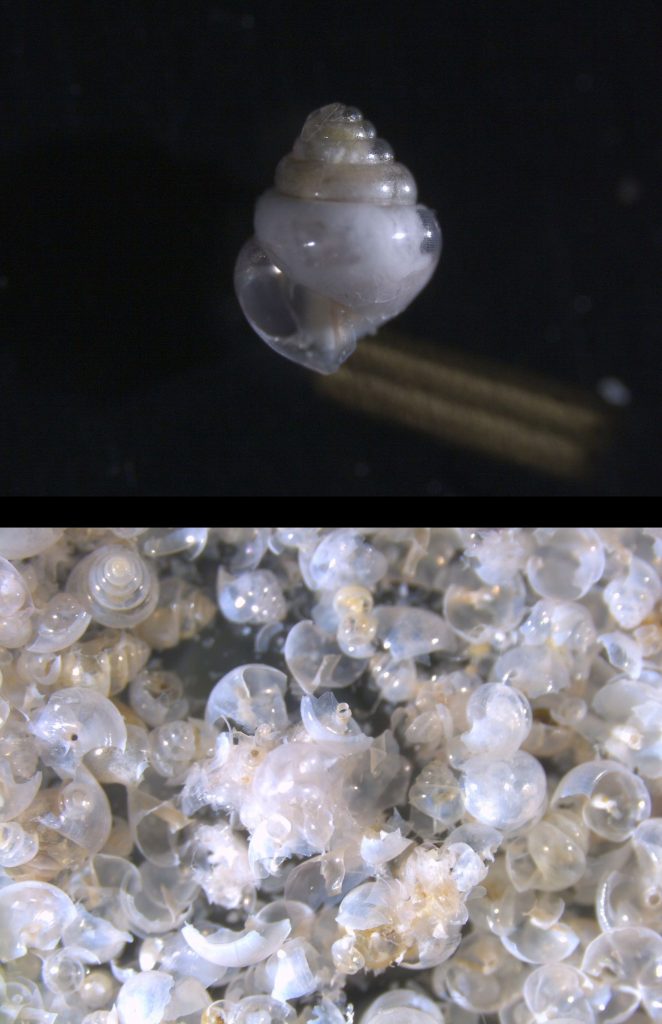
Calcifiers, including pteropods, use bicarbonate ions to form CaCO3 (Middelburg et al., 2020), removing bicarbonate ions and producing hydrogen ions and CO2 during this process. On short time scales, CaCO3 production decreases surrounding seawater alkalinity, with CaCO3 sinking and dissolution producing alkalinity (Middelburg et al., 2020). This has the ability to weaken the impact of the soft tissue pump (production of organic carbon) that removes CO2 through photosynthesis (Liang et al., 2023; Middelburg et al., 2020) and creates what is known as the term the carbonate counter pump. Pteropodas can also be some of the early indicators of ocean acidification due to their sensitivity to ocean pH, making them important to study in the context of climate change.
Ben is currently picking pteropods from samples in the North Atlantic as part of his PhD collected during the BIO-Carbon cruises in 2024, which will eventually feed into this database.
Middelburg, J. J., Soetaert, K., & Hagens, M. (2020). Ocean alkalinity, buffering and biogeochemical processes. Reviews of Geophysics, 58, e2019RG000681. https://doi.org/10.1029/2019RG000681
Liang, H., Lunstrum, A. M., Dong, S., Berelson, W. M., & John, S. G. (2023). Constraining CaCO3 export and dissolution with an ocean alkalinity inverse model. Global Biogeochemical Cycles, 37, e2022GB007535. https://doi.org/10.1029/2022GB007535